Black sumac
Rhus copallinum
Last reviewed: August 2026
Toxicity unknown
Black sumac (Rhus copallinum) is not listed by the ASPCA Animal Poison Control Center (opens in new tab) or the other sources we check, so we have no verdict for it either way. Absence from those lists is not a clearance. If your pet shows symptoms after eating any plant, call the ASPCA at (888) 426-4435.
Light
full sun
Water
low
Size
72"–216" H × 72"–180" W
Bloom
Jul, Aug, Sep
Native to
AL, AR, AZ, CT and 33 more states
Pollinators
bees, wasps, flies, butterflies
Before you buy
Your city may pay you to plant this
Cities and water utilities offer rebates for replacing lawn with native and water-wise plants. We track 450 programs across 44 states, each with a link to the provider and the date we last checked it.
Find rebates in your areaBrowse plants for this ecoregion
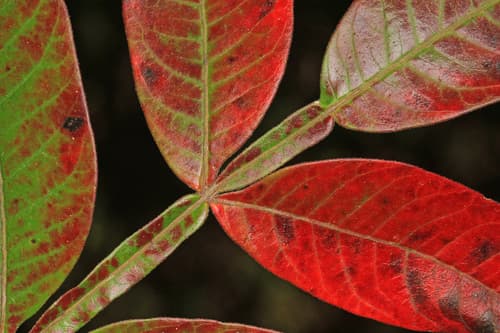
A deciduous shrub or small tree known for its winged leaf stems and brilliant fall color, ranging from orange to deep red. Its compound leaves turn shining red in autumn, giving rise to the common name. Forms dense thickets by root suckering and produces clusters of small greenish-yellow flowers in late summer, followed by red, berry-like fruit clusters that persist into winter.
In an HOA neighborhood
Black sumac is an HOA-friendly choice in the right placement. Maintenance level: moderate. Tidiness: 2 out of 5.
Works well in: naturalized borders, wildlife hedgerows, slope stabilization.
- Spreads by root suckers and can form dense colonies if not maintained
- May read as weedy to some reviewers because of its thicket-forming habit
Wildlife value
The late-summer flowers draw a wide range of pollinating insects including bees, wasps, and flies. Its dense red fruit clusters, called drupes, persist through winter and provide an important food source for many bird species when other food is scarce.
Common questions
- How much sun does Black sumac need?
- Black sumac grows best in full sun conditions.
- When does Black sumac bloom?
- Black sumac blooms in July, August, and September.
- Where is Black sumac native?
- Black sumac (Rhus copallinum) is native to AL, AR, AZ, CT and 33 more states, per the World Checklist of Vascular Plants (Kew).
- What pollinators does Black sumac attract?
- Black sumac draws bees, wasps, flies, and butterflies.
- Is Black sumac HOA-friendly?
- Black sumac is generally an HOA-friendly choice in the right placement, with moderate maintenance.
Native range data from the World Checklist of Vascular Plants (Kew). Pollinator and host plant associations compiled from GBIF, iNaturalist, and published ecological literature.
Ready to grow Black sumac? Add it to your garden in Pollinator Patch to track it and get season-by-season care guidance.
Not sure where to start? Take the 2-minute yard quiz